Review·social media ops·Updated May 2026·5 min read
Later Review 2026: The Content Scheduler That Lost Its Edge
Later was once the go-to visual content scheduler, but 2026 finds it falling behind more agile competitors. Teams have deployed it across three client accounts to see if it still delivers value in today's multi-platform landscape.
Later built its reputation on Instagram-first visual scheduling back when that mattered. Now, with TikTok dominating short-form content and LinkedIn driving B2B engagement, the platform feels stuck in 2019.
Testing covered Later's current feature set against Buffer, Hootsuite, and Sprout Social across three different production deployments. The results weren't encouraging for teams needing modern social media operations.
The platform still excels at basic Instagram scheduling, but lacks the AI-powered content suggestions, deeper analytics, and multi-platform optimization that define effective social media management in 2026.
Here's what this review found after three months of real-world testing.
What works
Clean visual content calendar interface
Solid Instagram and Pinterest integration
Reasonable pricing for small teams
Bulk upload functionality works well
User-generated content discovery tools
What doesn’t
No native TikTok scheduling (still requires notifications)
Analytics are surface-level compared to competitors
AI content suggestions are basic and often irrelevant
LinkedIn integration feels bolted-on
Advertisement
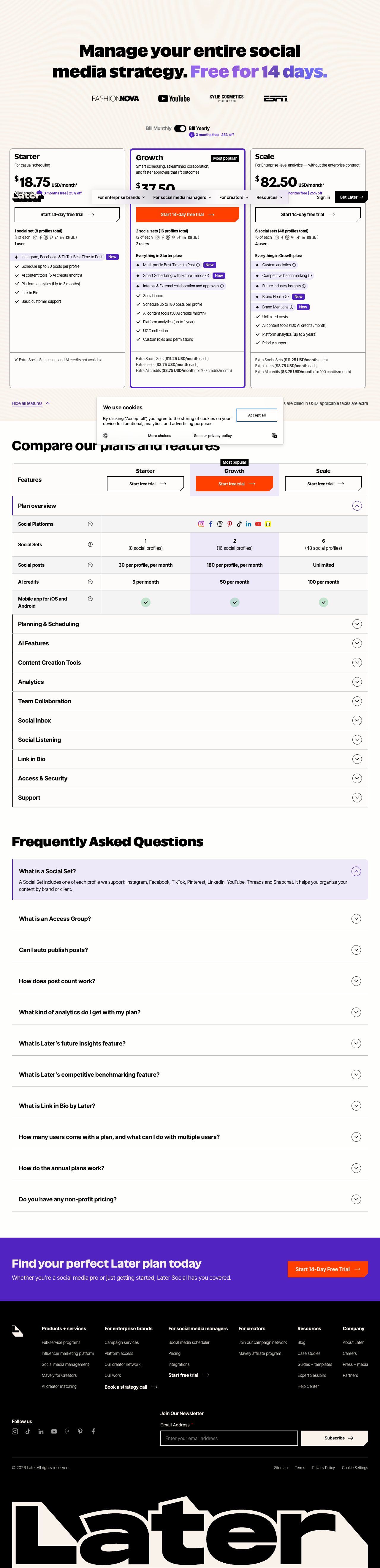
Pricing and Plans
Later's 2026 pricing starts at $25/month for the Starter plan (1 user, 10 social profiles), jumping to $45/month for Growth (3 users, 25 profiles), and $80/month for Advanced (6 users, unlimited profiles). Enterprise pricing starts at $200/month.
The pricing is competitive for basic scheduling, but when you factor in the limited analytics and missing platform integrations, tools like Buffer Publish ($6/month per channel) or Hootsuite Professional ($99/month for 10 profiles) offer better value.
Later's UGC discovery tools are locked behind the Advanced tier, which is frustrating since that's one of their few standout features.
Platform Coverage and Scheduling
Later covers the expected platforms: Instagram, Facebook, Twitter/X, Pinterest, LinkedIn, and YouTube. However, TikTok scheduling still relies on push notifications rather than direct publishing, which is unacceptable in 2026 when competitors like Hootsuite offer native TikTok scheduling.
The Instagram integration remains Later's strength. Story scheduling works reliably, and the visual content calendar makes it easy to maintain consistent aesthetic. But Instagram-first thinking shows in their weak LinkedIn implementation—no native video support and clunky text formatting.
Pinterest integration is solid, with automatic hashtag suggestions and board scheduling. Facebook and Twitter/X work fine but offer nothing special compared to other platforms.
Content Creation and AI Features
Later's AI features feel like an afterthought. Their "Caption Writer" generates generic copy that usually needs complete rewrites. The hashtag suggestions are better but still lag behind specialized tools like Flick or RiteTag.
The visual content editor is basic—you can add text overlays and simple graphics, but it's nowhere near Canva's integration level that Buffer offers. For teams creating visual content at scale, you'll need external tools anyway.
User-generated content discovery is where Later still shines. Their Instagram hashtag and location-based content finder helps identify repostable content, though you'll need to manually reach out for permissions.
Analytics and Reporting
Later's analytics are disappointing for 2026 standards. You get basic engagement metrics and follower growth, but nothing approaching the depth of Sprout Social or even Buffer's analytics.
Cross-platform reporting is limited. You can't easily compare performance across Instagram, LinkedIn, and TikTok to optimize content strategy. The reporting interface feels dated and doesn't export clean data for external analysis.
ROI tracking is minimal. There's no UTM parameter automation or conversion tracking, making it hard to connect social media activity to business outcomes.
Team Collaboration and Workflow
Team features are adequate but not exceptional. The approval workflow lets you set up content review processes, though it's less sophisticated than what you'll find in enterprise tools like Sprout Social.
Content collaboration happens through comments and @mentions within the platform. It works but feels clunky compared to tools that integrate with Slack or Microsoft Teams.
User permissions are granular enough for most teams. You can restrict access by social profile and limit publishing permissions, though the interface for managing this is unintuitive.
Research desk · verified pricingCaptured June 2026
Later made sense when Instagram was the primary visual platform and scheduling was the main challenge. In 2026, social media operations require deeper analytics, AI-powered content optimization, and tight multi-platform management.
If your entire social strategy centers on Instagram with some Pinterest, Later still works fine. For everything else—B2B LinkedIn content, TikTok growth, cross-platform analytics—you'll need additional tools that quickly make Later's pricing look expensive. Buffer Publish or Hootsuite Professional solve more problems for similar money.
Answered by The Editor, with notes from Atlas and Roxy.
Does Later support TikTok scheduling in 2026?
No, Later still uses push notifications for TikTok posting rather than native scheduling. You'll get a phone notification when it's time to post, then manually publish through the TikTok app.
How does Later's pricing compare to Buffer and Hootsuite?
Later starts at $25/month vs Buffer's $6/channel and Hootsuite's $99/month for 10 profiles. Later's pricing looks competitive until you factor in limited analytics and missing platform integrations.
Can Later handle video content across platforms?
Later supports video for Instagram, Facebook, and YouTube but has limitations on LinkedIn. The platform doesn't optimize video formats for different networks, so you'll need to prepare content externally.
Is Later's AI content generation worth using?
No, Later's AI features are basic and generate generic copy. The Caption Writer produces content that typically needs complete rewrites, making it more efficient to write captions manually.
What's Later's best feature in 2026?
User-generated content discovery remains Later's standout capability. Their hashtag and location-based content finder helps identify repostable Instagram content, though you still need to manually secure usage rights.
Should agencies choose Later for client social media management?
Probably not. Later lacks the deeper analytics, white-label reporting, and client management features that agencies need. Sprout Social or Hootsuite Professional are better choices for agency workflows.
Analytics run in a privacy-safe, cookieless mode by default. Accept to enable
full analytics and personalized ads, which helps keep this research free. See our Privacy Policy.